
If you are currently looking at global map layouts and dreaming about walking through a beautiful, historic campus in the UK, navigating the bustling cities of Australia or enjoying the precision of an engineering hub in Germany, you are far from alone. The number of students crossing borders for higher education has soared into millions annually. However, before you can fly out, there is one universal checkpoint you must pass: the IELTS.
Many first-time test takers look at the IELTS as a massive, intimidating wall. There is a common misconception that you need to be an English literature genius or have a flawless, native accent to score a Band 7 or higher. Let’s clear the air right now: the IELTS is not an IQ test nor is it a trap designed to catch you failing. It is simply a highly structured language proficiency assessment. It doesn’t care how flowery your vocabulary is; it cares about how clearly, logically, and effectively you can communicate under specific constraints.
When figuring out how to prepare for IELTS, the initial hurdle is often just information overload. Between endless online forums, complex practice booklets, and conflicting advice from well-meaning friends, it’s easy to feel lost before you even write your first essay.
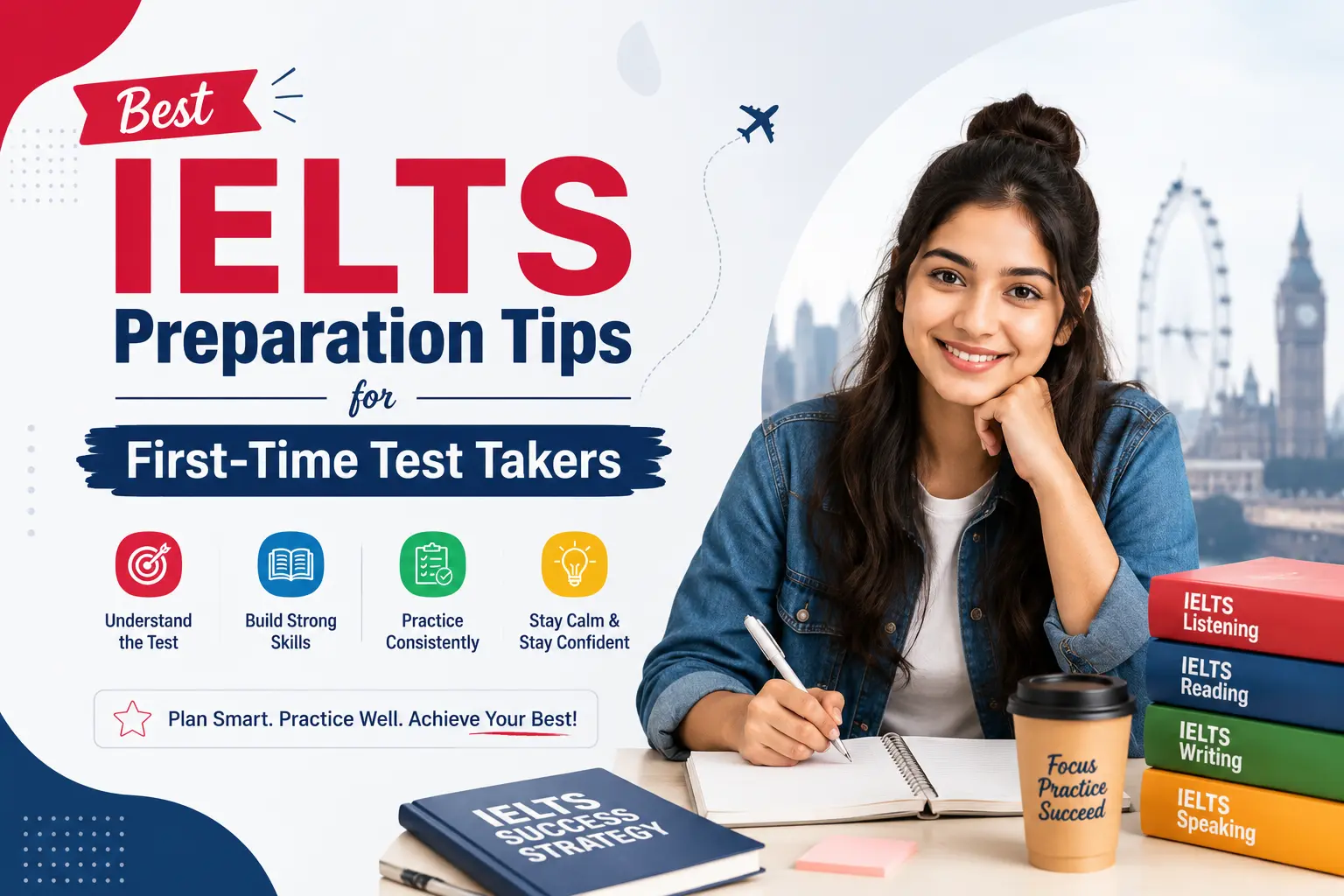
To help you cut through the noise, we have compiled a straightforward, practical guide containing 10 IELTS preparation tips to guide your study routine.
The Realistic 10-Tip Strategy for Beginners
1. Shift Your Mindset From “Studying” to “Training”
The IELTS behaves much more like a fitness test than a history exam. You cannot memorize answers the night before. Instead, treat your preparation as daily skill training. Consistency is key; practicing for 30 minutes every day yields significantly better results than cramming for 5 hours straight on weekends.
2. Gauge the Clock Early On
Understanding the ideal IELTS preparation time for beginners is crucial. Most students need a structured timeline of 4 to 8 weeks. This allows your brain to transition from just understanding English to actively performing tasks like writing 250 words or answering 40 fast-paced listening questions under strict, realistic time pressure.
3. Set Up Your Dedicated Home Lab
If you are learning how to prepare for the IELTS exam at home, consistency requires a proper environment. Find a quiet corner free from phone notifications. Practice reading long-form journalistic articles or research papers on a screen or paper (depending on your chosen test format) to build up the stamina required for the intensive 60-minute reading block.
4. Listen to Multi-Accent Audio Material
The Listening section features a mix of British, American, Canadian and Australian speakers. If you only watch Hollywood films, you might struggle with a sudden Kiwi or Scottish accent during the exam. Mix up your media intake by listening to international news networks, global podcasts, or educational lectures to broaden your auditory range.
5. Prioritize “Task Achievement” in Writing
You do not need to use archaic, complex words to impress the examiner. In fact, using vocabulary incorrectly can actively hurt your score. Instead, focus heavily on answering exactly what the prompt asks, keeping your arguments well-structured, and ensuring your spelling and grammar remain clean. This foundational focus acts as an excellent, reliable IELTS exam preparation guide.
6. Speak to Your Reflection or a Recording App
The Speaking module is a live conversation, which often makes it a major source of anxiety for beginners. To build confidence, practice these key tips to prepare for IELTS: pick everyday topics, talk aloud to yourself in a quiet room and record it. Listen back specifically to check if you are speaking too fast out of nervousness or pausing excessively.
7. Learn to Move On from Missed Questions
In the Listening and Reading modules, getting stuck on a single difficult question is a trap. If you miss an audio cue or can’t find a specific answer in a text paragraph, leave it blank or make a quick guess, and move on immediately. Do not sacrifice the next three easy questions just because you were overthinking the previous one.
8. Build a Synonyms Dictionary
The Reading test is essentially a giant game of hide-and-seek using synonyms. The question will rarely use the exact same words as the reading passage. When practicing at home, keep a running notebook of words and their common equivalents (e.g., decrease / decline / plummet).
9. Get Familiar with the Counting Rules
In the Writing and Listening components, instructions like “NO MORE THAN TWO WORDS” or “WRITE AT LEAST 150 WORDS” are absolute laws. Writing 149 words or ignoring the word limits in blanks will automatically cost you valuable marks, regardless of how accurate your English is.
10. Audit Your Progress with Real Formatting
Don’t just read tips, apply them under strict exam conditions. Take at least three full-length mock tests using the official layout sheets before your actual test date. This helps you build the physical and mental endurance needed to sit through the Reading, Listening, and Writing sections back-to-back.
At the end of the day, learning how to prepare for IELTS successfully comes down to understanding the system and training your habits. Approach the test methodically, treat your errors as valuable data points to learn from, and don’t let initial low scores discourage you. With the right roadmap and steady practice, hitting your target band on your first attempt is completely achievable.
Streamline Your Study Abroad Journey with Vivid Edu Services
Navigating test prep while simultaneously researching international universities, dealing with application deadlines, and preparing complex visa portfolios can quickly feel overwhelming. That is where partnering with a dedicated expert makes all the difference.
Vivid Edu Services, a premium overseas education consultancy based in Bangalore, specializes in removing the stress from this transition. They provide a highly structured language proficiency test program that goes far beyond basic textbooks. With experienced trainers, realistic mock test sessions, and customized score-improvement blueprints, they help you confidently secure your required band score.
Beyond your test preparation, the team at Vivid Edu Services provides comprehensive, end-to-end guidance for your entire global journey. From initial profile evaluation, personalized counseling, and course selection across premier destinations like France, Germany, the UK, and Australia, to meticulous student visa assistance and pre-departure planning, they ensure you are supported at every milestone.
Take the guesswork out of your future. Visit Vivid Edu Services today to schedule your free profile evaluation and transform your study abroad aspirations into a seamless reality!
